By Ivan Hadzhiev·
What kind of company should you buy custom merch from?
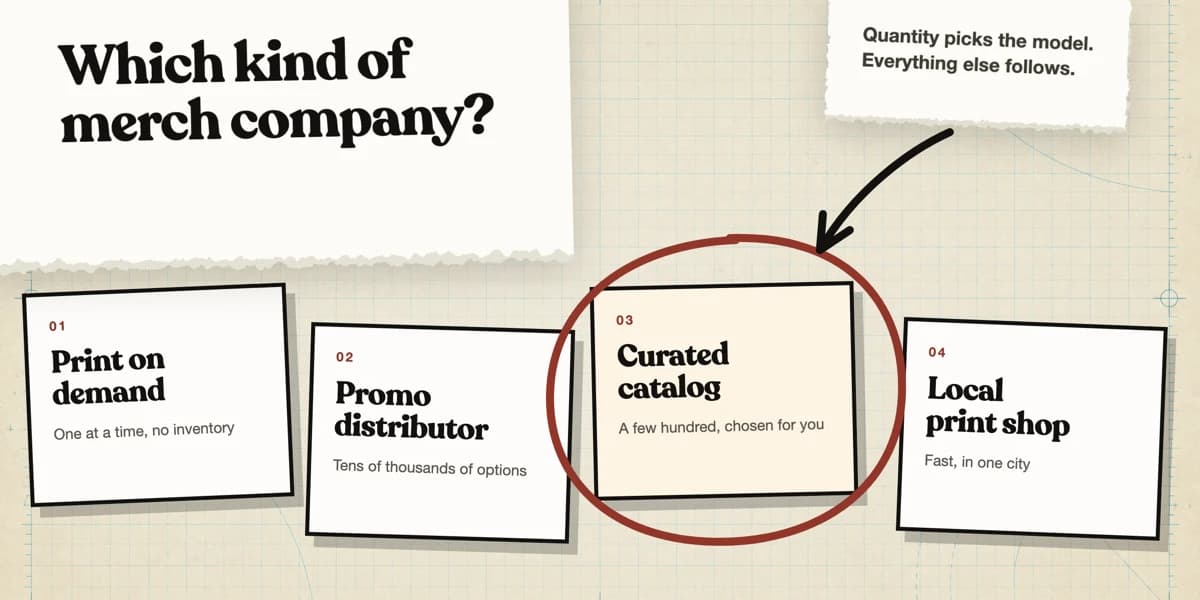
There are four kinds of company that will sell you custom merch, and they are not really competitors so much as different businesses that happen to print logos. Print-on-demand services make one item at a time with no inventory. Promotional products distributors resell enormous supplier catalogs. Curated catalogs publish a short, opinionated list. Local print shops decorate garments you or they supply. Picking well is mostly a matter of knowing which of those you are talking to, because each one is genuinely good at something and bad at something else. Here is how to tell them apart and which fits the order you are actually placing.
What kind of company should you buy custom merch from?
Match the model to the order. If you need one hoodie shipped to one person, use print-on-demand. If you need 5,000 branded items with a dedicated account manager and you have someone whose job is managing that, use a promotional products distributor. If you need 12 to 500 pieces that look like a brand rather than a trade show, use a curated catalog. If you already have the garments, or you need them this week in one city, use a local print shop.
The table below is the short version. The sections after it explain what each model is actually optimising for, which is usually the thing that decides whether you will be happy.
| Model | Catalog size | Typical order size | Best at | What you give up |
|---|---|---|---|---|
| Print-on-demand | Small, fixed | 1 and up | No inventory risk, individual fulfilment | Per-unit cost, blank selection |
| Promo distributor | Tens of thousands | Hundreds to thousands | Breadth, very large runs | Guidance, time spent choosing |
| Curated catalog | Hundreds | 12 to a few hundred | Decision speed, consistent quality | Breadth, the long tail |
| Local print shop | Whatever you bring | Varies, often 12 and up | Speed, face-to-face control | Sourcing, fulfilment, size runs |
What is a print-on-demand company and when does it make sense?
Print-on-demand prints one item at a time, after someone orders it, and ships it directly to that person. Nobody holds inventory. The model exists to remove the risk of guessing quantities and sizes, which is why creators and merch stores use it.
It makes sense when the order size is genuinely one, or when you are selling merch rather than giving it away and cannot predict demand. It makes much less sense for a team order, because per-unit cost does not improve with volume the way a bulk run does, and the blank selection is narrow by design.
What is a promotional products distributor?
A distributor resells from enormous shared supplier catalogs, often tens of thousands of items, usually through a salesperson who quotes you by email. This is the traditional promotional products industry and it handles most of the large corporate spend in the category.
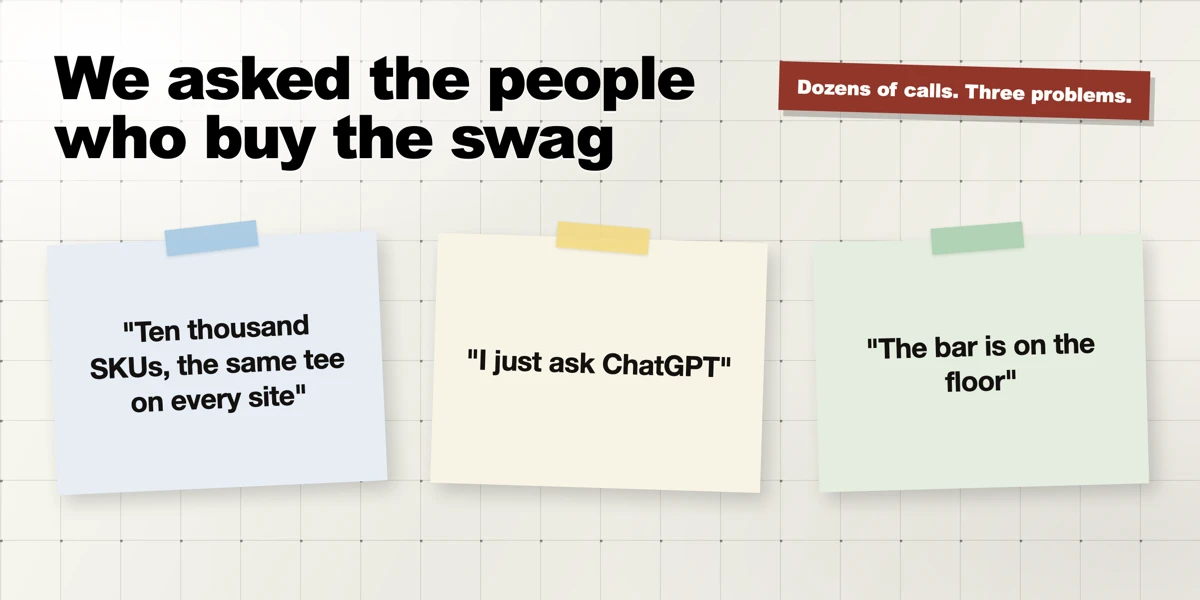
It is genuinely the right answer at scale. If you are running a 5,000-piece campaign with unusual items, a distributor can source things nobody else will. The tradeoff is that the catalog is so large it provides no guidance, and the buying experience runs on quote requests and PDFs rather than published prices. When we ran customer discovery with the people who buy merch at startups, the process was the thing they complained about most, ahead of price.
What is a curated merch catalog?
A curated catalog publishes a deliberately short list instead of everything available. The premise is that the hard part of buying merch is not access to products, it is deciding, and that a few hundred good options is more useful than ten thousand indifferent ones.
For reference on what short means in practice: we publish 239 styles across 21 brands from 6 suppliers. That is the whole catalog, and it is a tiny fraction of what those suppliers offer.
This model fits the 12-to-a-few-hundred order where the merch represents the brand and someone will notice if it feels cheap. It is the wrong model if you need something genuinely unusual, because the thing that makes it fast is the same thing that makes it narrow.
When should you just use a local print shop?
When speed and physical control matter more than sourcing. A local shop can often decorate in days rather than weeks, you can look at a proof in person, and you can bring your own garments if you already have them.
The limits are real though. Most shops decorate rather than source, so the blank selection is whatever their supplier stocks, size runs can be awkward, and they generally will not pick, pack and ship to 60 home addresses. If your team is distributed, that last one usually decides it.
How do you choose between them?
Three questions settle it almost every time. How many pieces, where are they going, and who is doing the choosing.
Quantity sets the model: one piece means print-on-demand, thousands means a distributor, and the wide middle is a curated catalog or a local shop. Destination sets the fulfilment: one office is easy for anyone, while individual home addresses rules out most local shops. And whoever is choosing sets how much curation is worth, because a marketing manager with fifteen other priorities values a short list far more than a procurement team that wants every option on the table.
A fourth question worth asking: do you need the same thing again in six months? Repeat programmes favour whoever can store inventory and reorder without you re-deciding every time.
What should you ask any merch vendor before ordering?
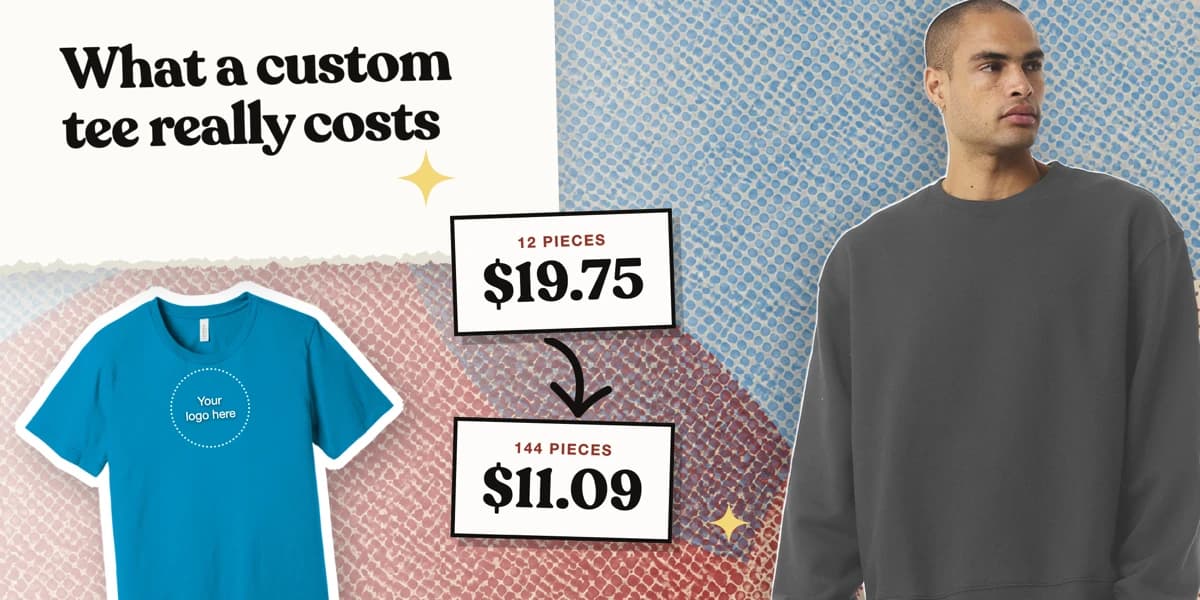
Ask for the per-unit price at your actual quantity, not a price range. The per-piece cost at 12 and at 144 are very different numbers, and a vendor who will only answer in ranges is usually quoting you the volume price.
Ask what the minimum is per style rather than per order, because that is where people get caught: a 50-piece order across four styles can fail four separate minimums. For reference, ours is 12 pieces on every style we decorate, and hard goods follow the minimum printed on each product page.
Then ask what is excluded. Shipping, a second print location, extended sizes and digitising for embroidery are the four that most often appear after the quote rather than in it.
Frequently asked questions
- What kind of company should I buy custom merch from?
- One of four models. Print-on-demand for single items with no inventory, a promotional products distributor for very large or unusual runs, a curated catalog for 12 to a few hundred pieces where quality and decision speed matter, and a local print shop when you need speed in one city or already have the garments.
- What is the difference between a promo distributor and a curated catalog?
- Catalog size and what the business optimises for. A distributor resells tens of thousands of items and sells breadth, usually through a salesperson and a quote. A curated catalog publishes a few hundred and sells decision speed. We publish 239 styles across 21 brands.
- Is print-on-demand cheaper than bulk custom merch?
- Not per unit. Print-on-demand removes inventory risk by making one at a time, so the per-piece price does not improve with volume the way a bulk run does. It wins when the order really is one or two pieces, or when you cannot predict demand.
- What is the minimum order for custom merch?
- It varies by vendor and by model. Ours is 12 pieces on every style we decorate, with hard goods following the minimum printed on each product page. Ask any vendor whether the minimum is per style or per order, because a mixed order can fail several style minimums at once.
- What should I ask a merch vendor before ordering?
- The per-unit price at your actual quantity rather than a range, whether the minimum is per style or per order, and what is excluded. Shipping, a second print location, extended sizes and embroidery digitising are the four costs that most often appear after the quote.
Work out which model fits you